

It was the summer of 2003 and ESPN was airing the WSOP Main Event. The show had main storylines, sub-plots, a cast of larger than life characters, and I was completely hooked. The centerpiece was Chris Moneymaker, the 27-year-old accountant from Tennessee who had qualified for the Main Event via an online satellite for just $86. One moment he’d be sitting at the table with his sunglasses on, bluffing players who were touted as legends of the game, and the next he’d be on the rail telling his father how close he’d just come to shitting his pants. Chris was the ultimate Everyman, the hero in whom we all saw ourselves.
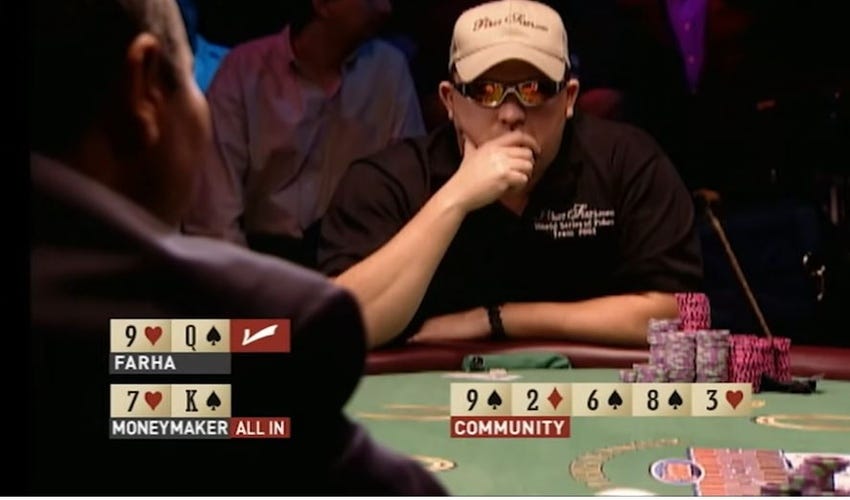
(Moneymaker’s famous bluff heads-up)
Across seven episodes, ESPN distilled thousands of hands into an addictive highlight reel of thrilling all-ins, audacious bluffs, and entertaining table banter. This game that had previously held no more importance in my life than Monopoly or Battleship had become my overnight obsession. I was not alone.
If you were a high school aged guy who liked sports, the odds were good you now also liked Texas Hold’em. Poker games sprang up across my hometown of Longmeadow, Massachusetts, and within a year the unofficial Longmeadow Poker Tour (LPT) was hosting multiple $5 re-buy tournaments each week. The same thing was happening at kitchen tables all over the country.
We started out playing small stakes cash games, friends and otherwise, but tournaments quickly took over. There was no conclusive finish to a cash game, just a session that ended when people got tired of rebuying or had to go home. Tournaments were different. Somebody won. In the end, one person sat behind all the chips. There was something far more satisfying about being the winner than a winner.
Along the way, there were the thrills that kept us coming back: that rush when looking down at pocket kings, the self-satisfied feeling after showing a bluff, and that stack of greens that told the table you’d been working the blinds all night. In truth, we were all pretty clueless when it came to sharp strategy, but that didn’t stop us from berating each other or rolling our eyes when somebody ‘sucked out’.
Over the next six months the LPT took on a life of its own. Fields grew, buy-ins crept from $5 to $10, and a rotating cast of classmates, acquaintances, and guys you’d never otherwise spend a Friday night with all found themselves around the same table. That was part of the appeal. Unlike a party, nobody got excluded from a poker game — we wanted the biggest fields we could get.
For a few hours, the usual hierarchies took a back seat. It wasn’t as simple as saying it didn’t matter if you were a freshman or a senior, a varsity athlete or the kid who ate lunch alone, but for the duration of a tournament, what mattered most was your chip stack. For someone who was just starting to sense that the social landscape was shifting in ways that weren’t going to favor him, that was a quietly intoxicating discovery.
It was soon apparent that some of the guys were there to see flops and get lucky, while others, myself included, were actually trying to outplay their opponents and overcome the element of luck. A few of us seemed sharkier than others, but none of us had any idea how complex the game truly was.
Around this time I had also begun donking around in the play money games on PokerStars. The real money games were just a click away, but being underage without a credit card, the only deposit option was a money order, which PokerStars required at a minimum of $200. From a net worth of approximately $600, that felt like a lot. Eventually the temptation became too much and I pulled the trigger.
I walked to the bank, marched up to the teller, and trying my best to sound nonchalant, asked them to make out a $200 money order to whatever generic sounding entity PokerStars had created for the handling of these financial transactions. For the next few days I checked my PokerStars account compulsively, waiting for my funds to appear, until finally they did.
Real Money Balance: $200.00.
I was so happy I could have cried, but there was no time for that. I opened two tables of $1/2 Limit Hold’em and sat glued to my screen for the next eight hours. By the time I logged off I was up over $250. I had never made so much money in such a short period of time. For the second time, poker had its hooks in me.
That night I withdrew $200 from PokerStars, protecting myself from ever being in the red. Over the next 18 months I made somewhere around $30,000 playing primarily Limit Hold’em, with tournaments, Sit ‘n’ Go’s, and Heads-Up SNGs mixed in. My game selection was all over the place and I had no consistent strategy or guidance, but I managed to cash out a steady stream of profits.
As my poker career blossomed, my academic career took a nosedive. In the span of just two months, in the middle of my junior year, I had dropped from honors math to standard math to remedial math. I had never been keen on doing my homework, and now I was doing almost none of it. As my GPA plummeted, my college prospects began to shrivel up. One Saturday afternoon, at my mother’s insistence, my father forced me off the computer and into the car for a road trip to local colleges.
When we arrived at the campus of Westfield State College, the nearest school to our home, we were greeted in the parking lot by a staff member who was just about to begin a tour of the campus for prospective students. She asked us if we’d like to join, and I turned to my father with a grave expression. “If we don’t have to go on the tour,” I said, “and can leave and go to lunch, I will go to this school.” Surprisingly, that was good enough for him, and minutes later we were at Burger King, Whoppers in hand.
I had no business being at Westfield State, and I knew it from day one. On the first day, there was an attendance-mandatory dorm-wide meeting to go over rules and codes of conduct. When the resident advisors came around to make sure nobody had stayed behind in their rooms, I was hiding in a closet. I wasn’t going to blind out of the $530 WCOOP 6-max event for some dumb shit meeting.
But college wasn’t a total loss. The roommate matching system, against all odds, had placed me with a guy named Chad Walker, who was quite likely the only other serious and winning poker player at the school. I don’t think either of us had even mentioned poker on the questionnaire that was used to match roommates. During our first week at Westfield State, Chad and I had been invited to a dorm room cash game. Nick Petrangelo, who was not a student at Westfield, was there that night on the invitation of his friend who was hosting the game. I don’t remember all that much from the game except that Nick lost, Chad was the big winner, and I more or less broke even. I remember not being especially fond of Nick and I had guessed the feeling was probably mutual. I had no idea that night that both of these guys would end up being two of the most important people in my life and career.
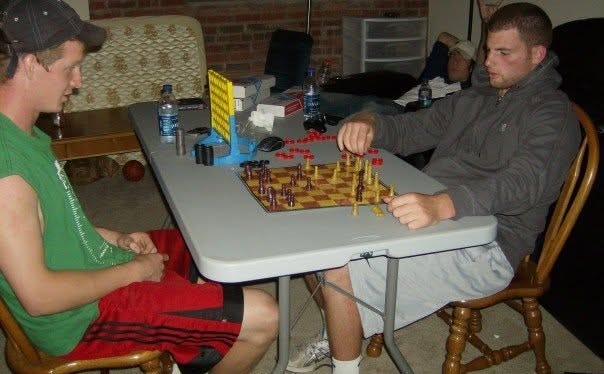
(Chad and Nick in 2007)
Despite having found a genuine friend in Chad, I largely regarded college as a pain in the ass. Every night I pleaded my case to my father over the phone, and every night my begging fell on deaf ears. After one semester he finally relented, and I was released from academic drudgery and free to pursue my career as a professional poker player.
In early 2006, I was 18 years old and living on my own with all of the freedom I’d always craved. I had despised structure my entire life: the alarm clocks, the homework, the bedtimes, being told when to sleep and when to show up and what to learn. For the first time, my time was entirely my own.
When I left school, the staple of my income had been playing 4 tables of $5/10 6-max Limit Hold’em on PokerStars. I’d done some rough calculations and estimated that if I worked a 40-hour week, I should earn somewhere in the neighborhood of $60,000 that first year. Within weeks of dropping out, I began dabbling in Heads-Up Sit and Go’s and quickly realized I had a knack for them, as well as a far greater passion for the format than I did for Limit Hold’em.
Over the course of that year, I transitioned from mostly Limit Hold’em to playing the $100 and $200 Heads-Up SNGs full time. Unaware of the existence of HUDs or tracking sites like Sharkscope, I kept track of my results on sticky pad notes. I had a rudimentary appreciation for variance and figured that by tracking and analyzing my statistics, I could better understand the nature of my fluctuations in luck, as well as the progress I was hoping to see.
I kept a two-column results tracker. A match lost would earn a tally in the L column, a win in the W. At the end of 100 matches I would subtract the losses from the wins, multiply the difference by the buy-in, and then subtract 100x the rake.
I remember my confidence rising and falling dramatically with the results of each completed sheet.
I knew very little about this world I had chosen to build a career in, and I showed almost no interest in reading the various forums, books, or strategy material that were available at the time. I almost never discussed strategy with other players. I was a feel player to the max, and I wouldn’t have been coherent if I’d tried to explain my thought processes at the time. In the poker world, I was a lone wolf.
My days followed a rhythm that felt genuinely exhilarating. My work day came to a close around 3am, at which point I would jump into the shower for what was a sort of decompression ritual. As the water fell over me, I would think back on my day and consider how things went, what I did well and what I could have done differently. I would dwell on what my trajectory looked like given that day’s results. In that first year a very good day of poker might see me profiting two or three thousand dollars, and I vividly remember the joy and optimism that I felt on those nights. At the time, it manifested as the recurring jubilant thought: “How is this actually my real life?”
On the nights when I’d lost two or three thousand dollars, I would still end up in the shower, but my decompression ritual went very differently. As the water pummeled me, I was an emotional mess, angry at myself, frustrated by the repeated “injustices.” I oscillated between a shallow sense of entitlement and a deep feeling of shame. On those nights, that meant never letting my emotions show that I had been beaten. Absurdly, this self-imposed rule extended even to the moments when I was alone. If I were to express my anger or sadness either verbally or physically I would feel ashamed at my lack of restraint and ‘emotional control’, a concept which I had greatly misunderstood.
Strangely enough, this immature outlook led me to stumble into a practice that would work wonders for me for years. While I wasn’t allowing myself a healthy release over the anger and sadness that I felt towards my bad fortunes on the felt, I think on some level I was aware of a need for catharsis, for some emptying of my emotions before going to bed. At some point early on, I decided that to feel bad for myself meant I had lost perspective and was being an ungrateful little bitch. How fortunate I was to be forging a career in this game that I absolutely loved.
To really feel it, I would build the alternate life narrative in my head. One in which I was in college, on a very traditional path. I would picture myself studying for an exam in a class that bored the living shit out of me. Then I might imagine myself waking up tired in my 180 square foot three-person dorm room and having to bundle up to walk across campus to an intro to philosophy class which I had absolutely dreaded. I conjured up this life in which I was meticulously tracking my spending on food, and gas, and weighing whether or not each experience or purchase was worth the ding it would inflict on the three-digit balance in my checking account.
After 5-10 minutes of building this vivid alternate reality, I’d let myself awaken to the reality where I was taking this shower, in my own apartment, in which the worst thing that had happened to me was that I’d lost some of the money that I’d never dreamed I would have at this stage in my life. It worked like a charm. Out of some mixture of gratitude and ego swelling, I was propelled out of my misery and exited the shower truly buoyant.
This gratitude practice worked for many months, until it didn’t. The story began to feel redundant as I’d started taking my freedom for granted. A sense of entitlement towards my career had begun to take root, and the eventual nail in the coffin was my recognition of how self-indulgent the whole exercise was, little more than a celebration of how awesome I thought I was.
At that point, the story I told myself escalated. I began to picture the people closest to me dying in very sad ways. I’ll spare you the morbid details, but I played the scenarios out through the funeral and the ensuing weeks and months in which my life was forever changed. It always ended in a mess of tears, and I loved that. I had been out of touch with this part of myself for so long, and it felt great to cry my eyes out. These nights of loss kicked off a period of emotional growth that I desperately needed. Imagining the loss of my loved ones gave me and my backwards ass approach to emotions “permission” to cry. I thought I was crying for my loved ones, which was perfectly permissible and perhaps even admirable by my unwritten rules. It was only many years later that I would come to understand that I was actually crying for myself, working through the fear that I wouldn’t make it as a pro, the shame that I had made bad decisions and been out-smarted by my opponents, and the frustration that this game wasn’t fair, and that tonight justice was not dispensed because I had lost.
As the year went on, I fell into a comfortable rhythm, playing just shy of 2,500 Heads-Up Sit and Go matches and profiting nearly $60,000. On the side I was also playing occasional tournaments on PokerStars, as well as a private cash game in person. Between the three, I would finish my first year playing professionally with just over $82,000 in profit. I felt firmly entrenched as a professional player, and life was good.
If 2006 had been the year of steady profit, a year in which I’d found my bearings, then 2007 would be the year of extremes — a year that would school me on both the intoxicating heights and the crushing lows that define a poker player’s existence.
Well, apparently you didn't need college for writing, because this was gripping all the way through. Thanks for sharing this slice of your life, Jon. Proud of you for following and achieving your dream ❤️
Great piece dude! I don’t think ya missed out all that much!